

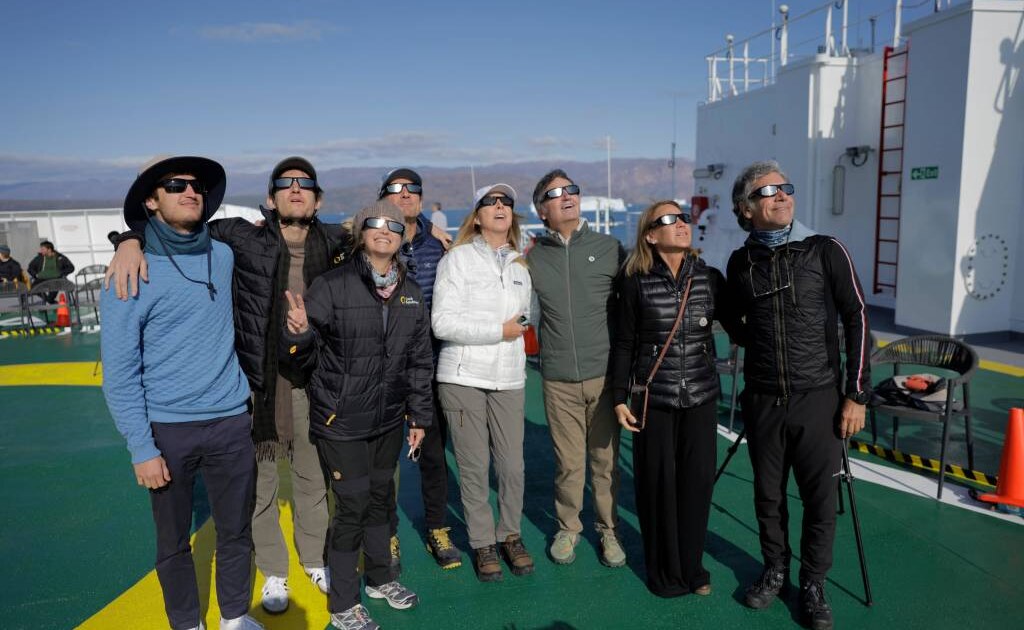

Quark Guests Witness Total Solar Eclipse in Greenland
Guests aboard Quark Expeditions' Ultramarine and Ocean Explorer witnessed more than two minutes of totality from remote East Greenland during the August 12, 2026, total solar eclipse.
Sam's Travel Itinerary may earn a commission when you book through qualifying links, at no additional cost to you.
Quark Expeditions guests traveled deep into East Greenland for a rare High Arctic experience on August 12, 2026: watching a total solar eclipse from the decks of Ultramarine and Ocean Explorer.
Both expedition ships were positioned in Harefjord, one of the innermost branches of Greenland's Scoresbysund fjord system and close to the center line of the eclipse's path of totality. From there, guests experienced approximately two minutes and 15 seconds of totality surrounded by one of the Arctic's most remote landscapes.
The event was the first total solar eclipse visible from the region since 2015, and Quark built the voyages around more than simply reaching the right coordinates. Eclipse specialists, expedition teams and photography guides spent time preparing guests for the brief window when the moon completely covered the sun.
Two Minutes and 15 Seconds of Totality
As the eclipse approached totality, guests gathered on deck aboard both ships and counted down the final seconds. The last portion of sunlight gave way to the diamond ring effect before the sun's corona appeared.
Quark described emotional reactions across the ships as the sky changed, with some guests brought to tears and others surprised by how quickly the approximately two minutes and 15 seconds passed.
Jake Morrison, expedition leader aboard Ultramarine, said months of planning went into preparing for the short period of totality. Harefjord ultimately provided guests with a clear view from the ship's deck.
Ocean Explorer expedition leader Amalia Goodall said the setting made the experience distinctive because the remote East Greenland landscape became part of the event rather than simply serving as a backdrop.
Why Quark Chose Harefjord
The August 12 eclipse's path of totality crossed Greenland and Iceland, with some of the longest totality available anywhere on Earth during the event.
Quark positioned Ultramarine and Ocean Explorer at Harefjord in Scoresbysund, placing the ships close to the eclipse's center line. The location combined favorable positioning for totality with a rarely visited High Arctic environment.
Scoresbysund's remoteness also fit the expedition nature of the voyages. Instead of viewing the eclipse from a populated destination, guests experienced the event from expedition ships surrounded by the rugged landscape of East Greenland.
Eclipse Experts Joined Both Ships
Quark brought specialist eclipse experts aboard both voyages to help travelers understand the science behind what they were about to experience.
Aboard Ultramarine, guests were joined by science journalist David Baron, author of American Eclipse. Baron had previously witnessed nine total solar eclipses around the world, making the August 12 event his tenth and his first in the High Arctic.
During the voyage, Baron presented “Scientific America: The Eclipse That Enlightened A Nation,” providing context and preparation ahead of the eclipse.
Baron said seeing the corona above Scoresbysund's rugged terrain made the setting a significant part of his tenth total eclipse experience.
Ocean Explorer hosted eclipse cartographer Michael Zeiler, founder of GreatAmericanEclipse.com and co-author of Atlas of Solar Eclipses: 2020 to 2045. During the 17-day voyage, Zeiler shared information about eclipse viewing, observational astronomy and celestial mechanics.
Zeiler had spent years mapping the 2026 eclipse and identified Scoresbysund as one of the strongest locations from which to experience it. The voyage gave him the opportunity to see those calculations translate into an actual viewing position from Ocean Explorer.
Photography Guides Helped Guests Prepare
Both voyages also featured Quark Expeditions' new Guided Photography Program, giving guests access to dedicated photography guidance before and during the eclipse.
Lead Photo Guide Scott Sinton worked with guests aboard Ultramarine, while Lead Photo Guide Stephen Bradley guided photographers aboard Ocean Explorer.
The program covered more than the eclipse itself. Guests also received guidance for photographing the surrounding polar landscape, combining the celestial event with the visual setting of East Greenland.
A Rare Expedition Experience in the High Arctic
Quark Expeditions has operated exclusively in the polar regions since 1991, and the Greenland eclipse voyages combined two elements central to expedition travel: reaching a remote location and being there for an event that could only happen at a specific moment.
In this case, the destination could not simply be visited again the following week for the same experience. The ships needed to reach the path of totality at the correct time, while expedition teams, eclipse experts and photography guides prepared guests for an event lasting just over two minutes.
For travelers aboard Ultramarine and Ocean Explorer, those preparations culminated on deck in Harefjord as daylight briefly disappeared and the solar corona emerged above Scoresbysund.
The setting also added another milestone to Quark's 35-year history of operating expeditions in the Arctic and Antarctica. By positioning both ships in remote East Greenland for the August 12 eclipse, Quark turned an astronomical event into a distinctly polar expedition experience.
Source: Quark Expeditions

Explore Cruises With Quark Expeditions
Explore more sailings and options from Quark Expeditions.
More Cruise News Worth Exploring
Recent stories from around the cruise world.


